


Furniture Exhibition in Hyderabad: How Architects Can Discover Custom Furniture for Modern Projects
Ask any architect in Hyderabad how they source furniture for a project, and you'll likely hear some version of the same frustration. Catalogues only show you so much. Photos on a manufacturer's website never quite capture how a material actually feels, how a finish reacts under different lighting, or whether a piece will hold up the way it's supposed to once it's sitting in a client's living room for a few years. You can scroll through hundreds of product pages and still walk away without a real sense of what you're working with. This is exactly the gap a good furniture exhibition in Hyderabad is designed to fill, and honestly, more architects should be treating these events as a core part of their sourcing process rather than an occasional detour.
Hyderabad's design and construction scene has grown considerably over the last several years, with more boutique residences, hospitality projects, and commercial interiors demanding furniture that doesn't look like it came off a mass production line. That shift has quietly changed what architects need from their sourcing process, and it's worth talking through why exhibitions have become such a valuable part of that equation.
Hyderabad's design and construction scene has grown considerably over the last several years, with more boutique residences, hospitality projects, and commercial interiors demanding furniture that doesn't look like it came off a mass production line. That shift has quietly changed what architects need from their sourcing process, and it's worth talking through why exhibitions have become such a valuable part of that equation.
The Problem With Sourcing Furniture Purely Online
There's nothing wrong with browsing online when you already know exactly what you're looking for. But most interesting furniture decisions in architecture don't start that way. They start with a rough idea, a mood, a material palette that needs to tie back to a building's interior language, and from that rough idea, an architect needs to actually see, touch, and sometimes sit on a range of options before anything crystallizes into a final choice.
Photographs flatten everything. A beautifully photographed chair might look stunning online and feel disappointingly flimsy in person. A wood finish that reads as warm and rich on a screen might look completely different under the actual lighting conditions of a project site. None of this is anyone's fault exactly, it's just an inherent limitation of buying furniture the way most people now default to buying everything else, through a screen. For architects, whose entire job depends on getting these tactile, sensory details right, that limitation matters a lot more than it does for the average online shopper.
Photographs flatten everything. A beautifully photographed chair might look stunning online and feel disappointingly flimsy in person. A wood finish that reads as warm and rich on a screen might look completely different under the actual lighting conditions of a project site. None of this is anyone's fault exactly, it's just an inherent limitation of buying furniture the way most people now default to buying everything else, through a screen. For architects, whose entire job depends on getting these tactile, sensory details right, that limitation matters a lot more than it does for the average online shopper.
Why In-Person Exhibitions Solve This So Well
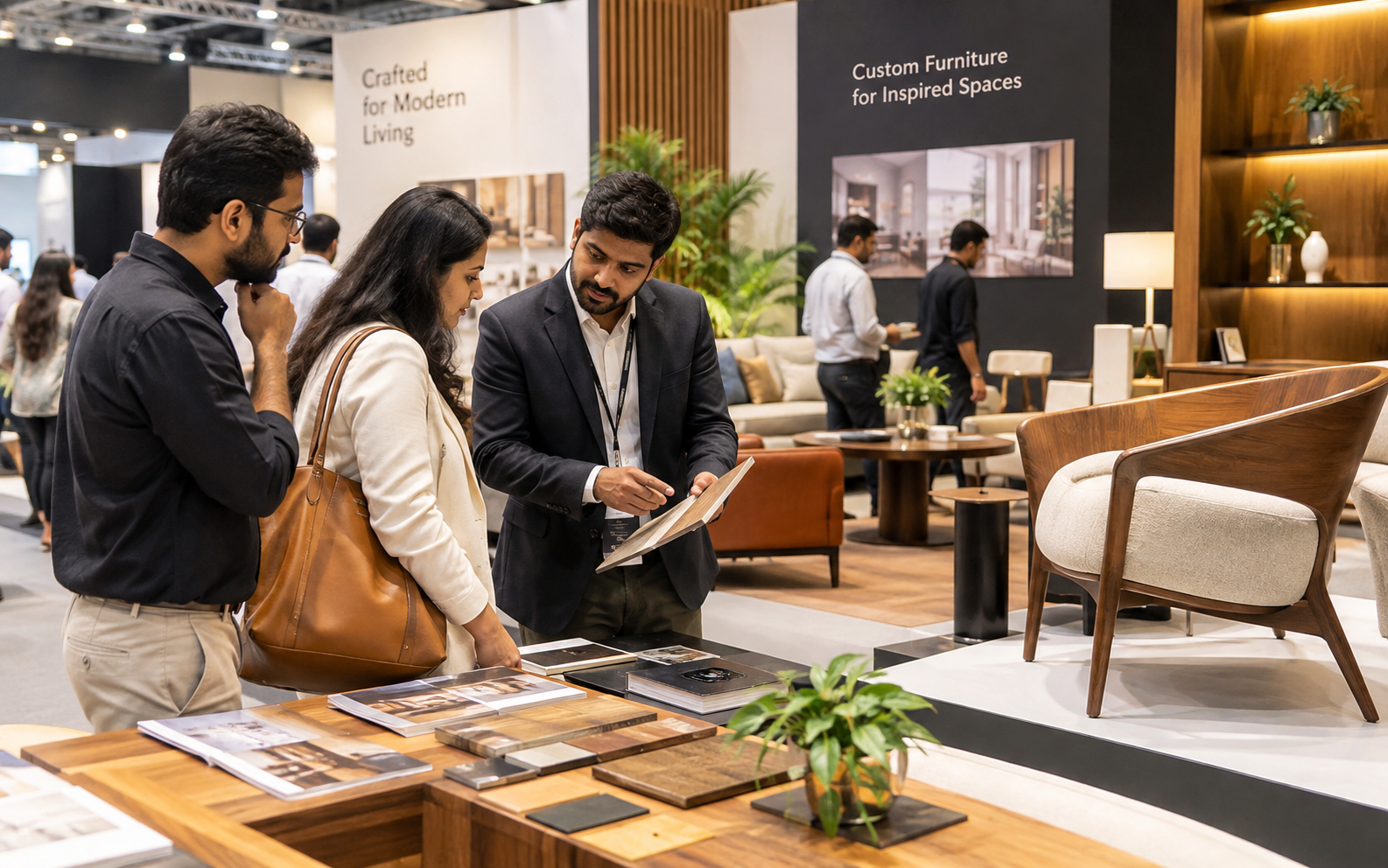
A well-organised furniture exhibition strips away that entire problem in one go. You can walk up to a custom dining table, run your hand across the grain, check how a drawer slides, notice the weight and balance of a chair before you commit to specifying it for forty rooms in a hospitality project. That kind of direct, sensory evaluation simply cannot be replicated through a digital catalogue, no matter how good the photography or how detailed the product description.
There's also the conversation factor, which honestly might be even more valuable than the physical inspection itself. At a good exhibition, you're not talking to a customer service chatbot or waiting three days for an email response. You're standing in front of the actual craftsman, designer, or manufacturer who made the piece, and you can ask the specific, sometimes oddly particular questions that only come up when you're deep into a live project. Can this finish be customised to match a specific paint code? What's the lead time if we need forty units instead of four? Does this material hold up in a high-humidity environment, which matters a great deal in a city like Hyderabad? These are the exact kinds of questions that get real, useful answers in person, answers that often shape the final specification far more than the initial visual impression did.
There's also the conversation factor, which honestly might be even more valuable than the physical inspection itself. At a good exhibition, you're not talking to a customer service chatbot or waiting three days for an email response. You're standing in front of the actual craftsman, designer, or manufacturer who made the piece, and you can ask the specific, sometimes oddly particular questions that only come up when you're deep into a live project. Can this finish be customised to match a specific paint code? What's the lead time if we need forty units instead of four? Does this material hold up in a high-humidity environment, which matters a great deal in a city like Hyderabad? These are the exact kinds of questions that get real, useful answers in person, answers that often shape the final specification far more than the initial visual impression did.
Custom Furniture Is Where This Really Matters
For standard, off-the-shelf furniture, exhibitions are useful but not essential. Where they become genuinely indispensable is when a project calls for custom pieces, which is increasingly the norm rather than the exception in higher-end residential and hospitality work. Architects looking for custom furniture need to evaluate a maker's craftsmanship directly, not through a portfolio of past projects that may or may not reflect their current capability or material quality.
Exhibitions bring together a concentrated pool of custom furniture makers, from small studio craftsmen working in traditional techniques to larger manufacturers experimenting with newer materials and finishes, all under one roof. That concentration is genuinely rare. Normally, discovering this range of custom furniture options would mean weeks of individual studio visits scattered across the city, each one requiring its own appointment and travel time. An exhibition compresses that entire discovery process into a few focused days, letting an architect compare multiple custom furniture options side by side in a way that would otherwise be logistically exhausting.
Exhibitions bring together a concentrated pool of custom furniture makers, from small studio craftsmen working in traditional techniques to larger manufacturers experimenting with newer materials and finishes, all under one roof. That concentration is genuinely rare. Normally, discovering this range of custom furniture options would mean weeks of individual studio visits scattered across the city, each one requiring its own appointment and travel time. An exhibition compresses that entire discovery process into a few focused days, letting an architect compare multiple custom furniture options side by side in a way that would otherwise be logistically exhausting.
How This Fits Into Hyderabad's Broader Design Ecosystem
Furniture rarely exists in isolation on a project. It's part of a much larger interior language that includes lighting, textiles, flooring, and finishes, all of which need to work together cohesively. This is exactly why the better interior design exhibitions in the city don't just focus narrowly on furniture alone. They bring together a broader mix of interior products and design disciplines, giving architects a chance to think about a project holistically rather than sourcing each element separately from completely different, disconnected channels.
An interior exhibition in Hyderabad that's genuinely well curated becomes a kind of working session for architects, even if it doesn't feel like one on the surface. You walk from a furniture stall to a lighting display to a textile showcase, and ideas start connecting in ways that wouldn't have happened if you were sourcing each category separately over several unrelated weeks. That cross-pollination of ideas, seeing how a particular furniture finish might actually pair with a lighting fixture two stalls down, is one of the quieter but genuinely significant benefits of attending these events in person rather than sourcing everything remotely.
An interior exhibition in Hyderabad that's genuinely well curated becomes a kind of working session for architects, even if it doesn't feel like one on the surface. You walk from a furniture stall to a lighting display to a textile showcase, and ideas start connecting in ways that wouldn't have happened if you were sourcing each category separately over several unrelated weeks. That cross-pollination of ideas, seeing how a particular furniture finish might actually pair with a lighting fixture two stalls down, is one of the quieter but genuinely significant benefits of attending these events in person rather than sourcing everything remotely.
Building Relationships That Outlast a Single Project
There's one more benefit worth mentioning, and it's one that experienced architects tend to appreciate more than younger ones just starting out. The relationships built at exhibitions often extend well beyond the immediate project you're sourcing for. A custom furniture maker you meet and genuinely hit it off with at an exhibition often becomes a long-term collaborator, someone you return to project after project because you already understand each other's working style, communication expectations, and quality standards. That kind of trust takes time to build, and exhibitions offer a uniquely efficient environment for those first real conversations to happen.
Bringing It All Together
For architects working on modern projects in Hyderabad, treating furniture sourcing as purely a digital, catalogue-driven process leaves a lot on the table, quite literally. The tactile inspection, the direct conversations with makers, and the concentrated access to custom furniture options that a good exhibition offers simply cannot be matched by browsing alone. And when that exhibition is thoughtfully curated to bring together furniture alongside the broader interior design ecosystem, the value only compounds further.
For architects looking to make the most of what Hyderabad's design scene currently has to offer, keeping an eye out for well-organised, well-curated design events is genuinely worth the effort, and this is exactly the kind of experience Darc Build has been working to bring to the city.
For architects looking to make the most of what Hyderabad's design scene currently has to offer, keeping an eye out for well-organised, well-curated design events is genuinely worth the effort, and this is exactly the kind of experience Darc Build has been working to bring to the city.
FAQs
1. Why should architects visit a furniture exhibition in Hyderabad?
It allows architects to explore furniture in person, compare materials and finishes, and connect directly with manufacturers and designers.
It allows architects to explore furniture in person, compare materials and finishes, and connect directly with manufacturers and designers.
2. What are the benefits of sourcing custom furniture at an exhibition?
Architects can evaluate craftsmanship, discuss customisation options, understand lead times, and find solutions suited to specific project requirements.
Architects can evaluate craftsmanship, discuss customisation options, understand lead times, and find solutions suited to specific project requirements.
3. Can architects customise furniture showcased at exhibitions?
Many manufacturers offer customisation in materials, finishes, dimensions, colours, and designs, depending on the product and project requirements.
Many manufacturers offer customisation in materials, finishes, dimensions, colours, and designs, depending on the product and project requirements.
4. How does an interior design exhibition help architects?
It brings furniture, lighting, textiles, and other interior solutions together, helping architects develop a more cohesive design approach.
It brings furniture, lighting, textiles, and other interior solutions together, helping architects develop a more cohesive design approach.
5. Can furniture exhibitions help architects find long-term suppliers?
Yes. Direct interactions with manufacturers and furniture makers can help architects build professional relationships for future projects.
Yes. Direct interactions with manufacturers and furniture makers can help architects build professional relationships for future projects.