


Why Are Furniture Exhibitions in Delhi Becoming Important for Architects Specifying Custom Furniture?
Ask any architect about the most stressful part of a project, and a surprising number will say custom furniture.
The drawing is perfect. The client loves the render. Then the piece arrives at site and the leg is thicker than you detailed, the veneer doesn't match the sample, and the sofa that looked sleek on screen sits like a block. Weeks lost. A very awkward call with the client.
That's a big reason furniture exhibitions in Delhi have moved from "nice to attend" to something architects plan their year around.
The drawing is perfect. The client loves the render. Then the piece arrives at site and the leg is thicker than you detailed, the veneer doesn't match the sample, and the sofa that looked sleek on screen sits like a block. Weeks lost. A very awkward call with the client.
That's a big reason furniture exhibitions in Delhi have moved from "nice to attend" to something architects plan their year around.
Custom work depends on trust
Off-the-shelf furniture is easy. You pick it from a catalogue, and it shows up looking like the photo. Custom furniture is different. You're trusting a workshop to turn your sketch into a real object, and you usually haven't met the people doing it.
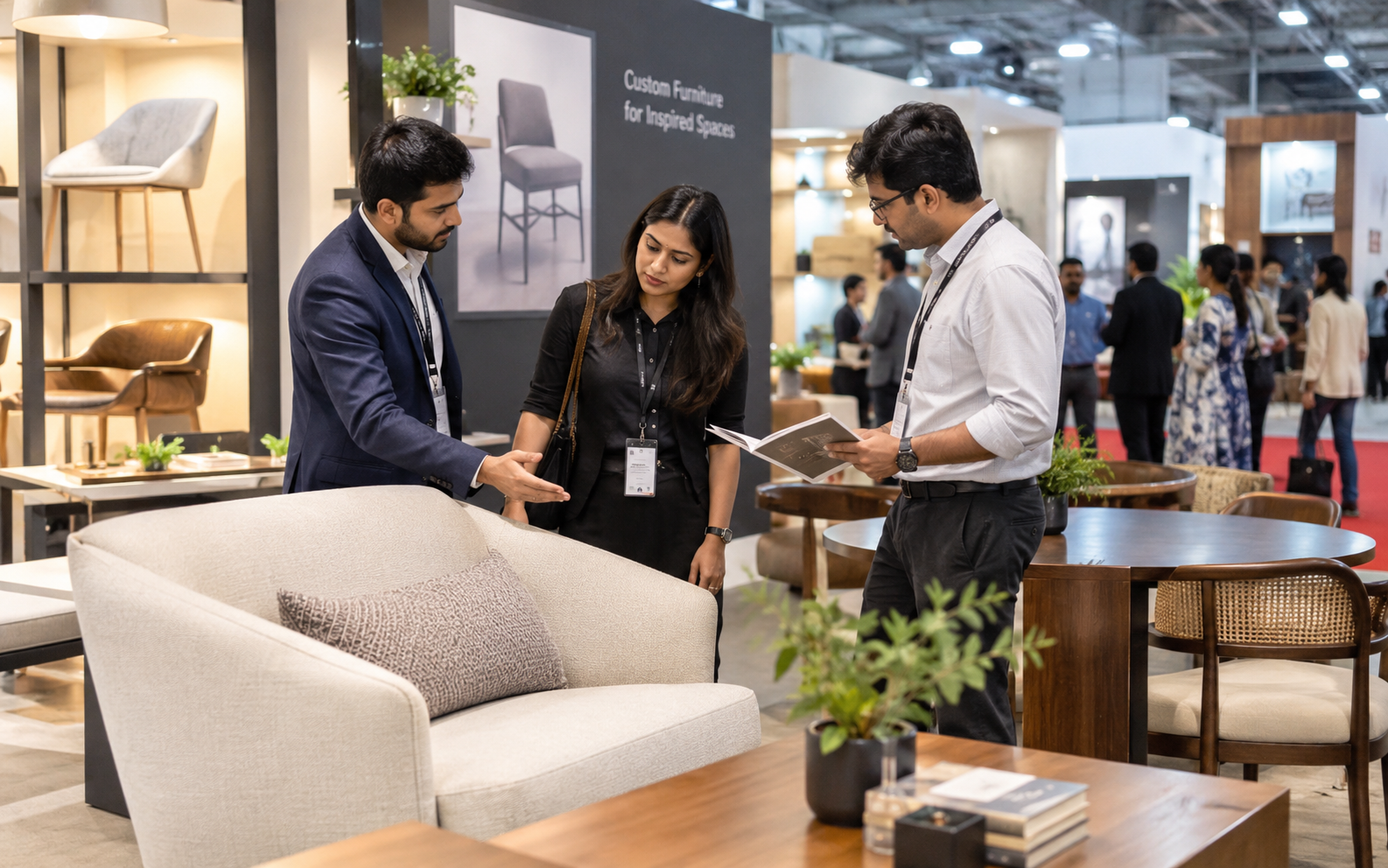
Exhibitions fix that. You stand next to a finished piece, check the joinery, flip a chair over and look at how it's built underneath. Quality shows up fast when you can see it up close. Rushed finishing, weak corners, uneven stitching: it's hard to hide any of it in person.
Exhibitions fix that. You stand next to a finished piece, check the joinery, flip a chair over and look at how it's built underneath. Quality shows up fast when you can see it up close. Rushed finishing, weak corners, uneven stitching: it's hard to hide any of it in person.
Meeting the maker, not just the salesperson
Here's the real gold. At a good show, the person at the stall is often the one who runs the workshop. So you can ask the questions that actually matter.
Can you hold this curve in solid wood, or will it need lamination? What's the minimum order for a custom run? How long will it take if I need forty chairs by March? What happens if the finish doesn't match?
Straight answers from a maker are worth more than any brochure. And you can tell within a few minutes whether someone knows their craft or is just pitching.
Can you hold this curve in solid wood, or will it need lamination? What's the minimum order for a custom run? How long will it take if I need forty chairs by March? What happens if the finish doesn't match?
Straight answers from a maker are worth more than any brochure. And you can tell within a few minutes whether someone knows their craft or is just pitching.
Delhi is a craft city
Delhi and the NCR region sit close to some of the strongest furniture-making and metal, cane and upholstery traditions in the country. Fabricators, carpenters and finishing specialists are all within reach, and many of them don't advertise much. They rely on word of mouth.
An interior exhibition in Delhi brings many of these makers into one hall. For an architect, that's a shortcut to a shortlist of people worth calling, instead of months of cold searching.
An interior exhibition in Delhi brings many of these makers into one hall. For an architect, that's a shortcut to a shortlist of people worth calling, instead of months of cold searching.
Seeing materials and furniture together
Furniture never lives alone. It sits against flooring, wall finishes, lighting and fabric, and the whole combination has to work.
At design exhibitions in Delhi, you see all of it in one place. You can hold a fabric sample against a timber finish, check how a metal frame looks beside stone, or notice that a particular brass tone pairs better than you expected. Decisions that normally take three rounds of sample requests can happen in an afternoon.
At design exhibitions in Delhi, you see all of it in one place. You can hold a fabric sample against a timber finish, check how a metal frame looks beside stone, or notice that a particular brass tone pairs better than you expected. Decisions that normally take three rounds of sample requests can happen in an afternoon.
Fresh ideas arrive by accident
Specifying the same four suppliers for every project gets comfortable, then stale. Clients notice, even if they can't say why.
Walking an exhibition breaks that habit. You spot a young studio doing joinery without visible screws, or a workshop reviving an old weaving technique, or a clever flat-pack system that cuts shipping costs for a hospitality project. Some of those ideas end up in your next drawing set.
Walking an exhibition breaks that habit. You spot a young studio doing joinery without visible screws, or a workshop reviving an old weaving technique, or a clever flat-pack system that cuts shipping costs for a hospitality project. Some of those ideas end up in your next drawing set.
Real talk about budgets and timelines
Custom furniture goes wrong most often over two things: money and time. Exhibitions let you have those conversations early, face to face, before anything is signed.
You can ask for rough ranges, compare how different makers quote, and find out who's honest about lead times. A maker who says "that'll take twelve weeks, not six" is a maker you can plan around. Better to hear it in a hall than in the middle of a project.
You can ask for rough ranges, compare how different makers quote, and find out who's honest about lead times. A maker who says "that'll take twelve weeks, not six" is a maker you can plan around. Better to hear it in a hall than in the middle of a project.
Clients are learning too
More clients now want to be part of the selection. Taking them to an exhibition, or showing them photos from one, makes the conversation easier. They touch the materials, see the quality, and understand why a handmade piece costs what it does.
That turns "why is this so expensive?" into "oh, I see." It's a gentler way to align expectations.
That turns "why is this so expensive?" into "oh, I see." It's a gentler way to align expectations.
How to get the most out of a visit
Go with a rough brief in mind. Photograph the pieces and the joinery, not only the stall boards. Collect cards and write a note on the back about what you liked. Ask for finish samples and lead times. And keep a gap in your schedule to wander.
Follow up within a week. Makers remember architects who reach out quickly, and good workshops fill their calendars early.
Follow up within a week. Makers remember architects who reach out quickly, and good workshops fill their calendars early.
Where Darc Build comes in
Events like Darc Build bring architects, designers, makers, and suppliers into the same space, which is exactly what custom furniture specification needs. If you're planning a project with bespoke pieces, spending a day at Darc Build can save you weeks of back and forth later.
Arrive with questions, stay curious, and don't skip the chats. Many architects find their next trusted workshop at Darc Build, standing right beside a piece they couldn't stop looking at.
Custom furniture is a relationship business. Exhibitions are where those relationships start.
Arrive with questions, stay curious, and don't skip the chats. Many architects find their next trusted workshop at Darc Build, standing right beside a piece they couldn't stop looking at.
Custom furniture is a relationship business. Exhibitions are where those relationships start.